
How therapy services are billed directly affects both compliance and reimbursement.
The Medicare 8 minute rule plays a key role in determining how providers calculate billable units based on treatment time. By applying this rule correctly, healthcare professionals can avoid errors and ensure accurate claims.
For clearer guidance and support in staying connected to essential services, you can also explore helpful resources available through TAG Mobile.
1. What is the Medicare 8 Minute Rule?
The Medicare 8 minute rule is a billing guideline used under Medicare Part B to determine how healthcare providers charge for time-based services, especially in outpatient therapy such as physical or occupational therapy.
Under this rule, providers must spend at least 8 minutes delivering direct, one-on-one care for timed CPT services to be billable. Treatment time is then converted into 15-minute units, which are used to calculate reimbursement. This system ensures that billing accurately reflects the actual time spent with patients and helps standardize how therapy services are reimbursed.
>>> Read More: Medicare Part B Covers: A Simple Checklist of What’s Included
2. How the Medicare 8 Minute Rule Works?
To apply this rule correctly, providers must understand how treatment time translates into billable units. The system may seem simple at first, but accuracy is essential to avoid billing errors and ensure proper reimbursement.
Minimum Time Requirement
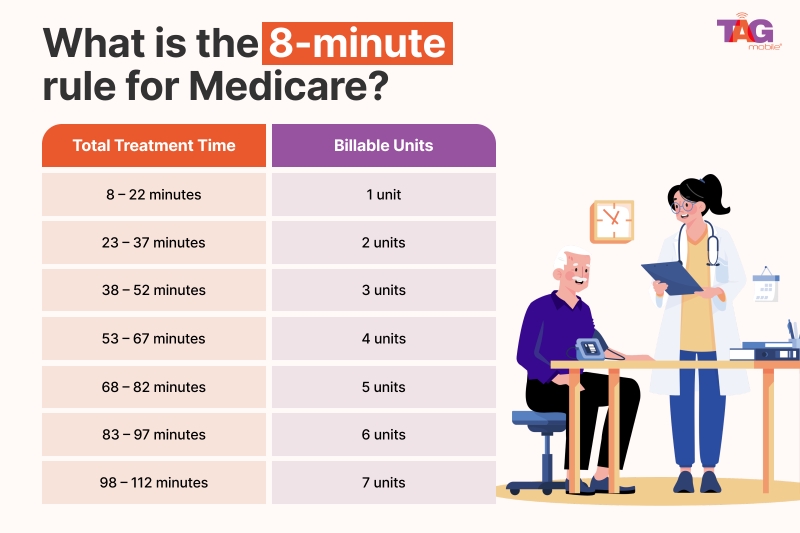
Under the Medicare 8 minute rule, a provider must deliver at least 8 minutes of direct, one-on-one care for a timed service for that final unit to be billable. Once the threshold is met, treatment time is converted into 15-minute units. For example, 8-22 minutes equals 1 unit, while 23-37 minutes equals 2 units.
Timed CPT Codes
The rule only applies to timed CPT codes, which are services billed based on the duration of treatment, such as therapeutic exercises or manual therapy. These codes require one-on-one, direct interaction with the patient and are calculated in 15-minute increments.
In contrast, untimed codes are billed as a single unit regardless of how long the service takes. While there are some Medicare 8 minute rule exceptions, they typically involve untimed services or specific billing scenarios that do not follow the standard time-based structure.

3. Medicare 8 Minute Rule Chart (Units by Time)
To make billing more consistent, Medicare uses a structured time-to-unit conversion system. This chart helps providers quickly determine how many billable units correspond to the total treatment time.
| Total Treatment Time (minutes) | Billable Units |
|---|---|
| 8 – 22 minutes | 1 unit |
| 23 – 37 minutes | 2 units |
| 38 – 52 minutes | 3 units |
| 53 – 67 minutes | 4 units |
| 68 – 82 minutes | 5 units |
| 83 – 97 minutes | 6 units |
| 98 – 112 minutes | 7 units |
4. Medicare vs Medicaid: Key Differences in Therapy Coverage
Medicare and Medicaid both provide healthcare support, but they differ significantly in how therapy services are covered.
Medicare is a federal program with standardized rules, including strict billing guidelines like the Medicare 8-minute rule for outpatient therapy. In contrast, Medicaid is state-managed, meaning therapy coverage, limits, and reimbursement policies can vary depending on where you live, often offering more flexibility for low-income individuals.
One major advantage of Medicaid is that it can qualify recipients for additional assistance programs beyond healthcare. For example, Medicaid beneficiaries may be eligible for the Lifeline program, a federal benefit that helps reduce the cost of phone and internet services.